
How Acupuncture Can Help Insomnia: A Chinese Medicine Perspective
If you're struggling to fall asleep, waking throughout the night, or never feeling truly rested, you're certainly not alone. Sleep concerns are one of the most common reasons people seek acupuncture and Chinese medicine.
Rather than simply masking symptoms, Chinese medicine aims to understand why your sleep has become disrupted. Different sleep patterns can point towards different underlying imbalances, allowing treatment to be tailored specifically to your constitution.
Below, I'll explore some of the common patterns we see in clinic, along with practical ways to support your sleep at home.
Understanding Your Sleep Pattern
If sleep is elusive for you, read on to figure out what might be causing your sleep problems, and perhaps find some golden nuggets you can implement to support your sleep at home!
Firstly, when looking at poor sleep we want to know if you have problems falling asleep or staying asleep, or perhaps both.
If you have problems falling asleep, we want to know what is happening during this time for you. Is your mind running rampant with random thoughts? Or are you anxiously spiralling? Are you just tossing and turning or ate you calm? How long are you lying there before you drift off, and once you drift off, do you wake easily? The answers to these questions help us (your Chinese Medicine Practitioner) attribute what organ systems need balancing directly.
Difficulty Falling Asleep
Problems falling asleep can often be attributed to what we call blood deficiency. In Chinese Medicine we say the spirit is housed in the blood, and if there is not enough blood, the spirit can become unanchored, agitated and float. This causes restless thoughts, inability to concentrate and fogginess, among other symptoms. This is particularly evident of an evening, as night is a yin time (opposed to the day which is considered yang). So, if someone has a blood deficiency, it becomes even more pronounced at night when yin is naturally meant to be in abundance. This unanchored yang (out of balance by lack of blood) is what causes the poor sleep.
Supporting your blood is key to help you fall asleep easily again. Although, depending on your level of depletion and your active consumption of blood, it will vary how long it takes you to build blood.
Over-exercising especially HIIT, pilates, running long distances multiple times a week, or even daily are said to deplete your blood. This is because blood regenerates with rest. So, to support your blood it is important to find a balance between movement and rest. Now, this is not your permission to turn on Netflix and become a couch potato, because blood does need some movement to regenerate. When healing from blood deficiency we recommend gentle movement daily, and small bursts of it. Practises such as walking, hatha or yin yoga, swimming or any other gentle form of exercise is supportive. We just want to avoid excessive anything. Chinese medicine is all about balance.
Ways to Support Blood at Home
A key way to build blood is to look at what you’re consuming and switch to more blood nourishing foods such as
chlorophyll rich foods/spirulina greens powder
bone broth
slow cooked beef
marrow
beef liver (can come encapsulated for ease)
collagen powder
legumes and beans
Stewed berries
Collagen Powder - I usually recommend a collagen drink in the evening to support the shen (spirit) & blood at further support rest
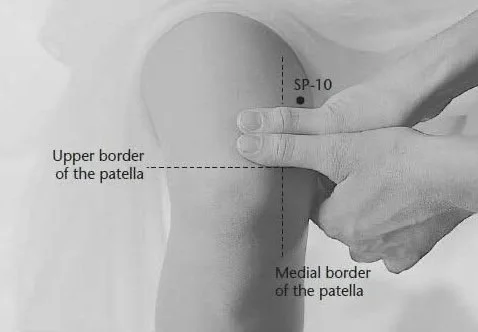
Acupuncture for Difficulty Falling Asleep
Building blood with the Acu-point SP10 is a favourite of mine, it is located on the inside of the leg, about 2-3 inches just above the outer/inner knee, your finger slides into a hollow and that’s how you know you’ve found it. This Acu-point can be stimulated with gentle pressure for 30-60 sec having a pause and doing it again 3-4 more times. You can repeat this multiple times throughout the day.
Chinese Herbal Medicine
Chinese Herbal medicine has blood nourishing herbs, and there is a formula that builds blood with 4 beautiful herbs! This formula is commonly added with another formula to match your constitution. Because behind every blood deficient person, we want to get to the root, or the why you became blood deficient. Chinese herbs are powerful allies in your healing journey, and as such they need to be prescribed by someone trained in Chinese medicine to understand how they work.
Waking Throughout the Night
Problems staying asleep such as sleeping lightly or waking at any noise, is a deeper type of deficiency. It can often signal that your HPA axis is dysregulated and you’re stuck in a stress response. As a result, you don’t feel safe enough to fall asleep. It could also indicate a yin deficiency. Yin is a deeper level than blood in the Chinese medicine framework, and often blood deficient sleep patterns, if left untreated, can progress to yin deficient sleep patterns. It is quite common to experience a mix of the two in clinic.
Supporting Yin
Treating yin deficiency has all the same at home protocols as treating blood deficiency, with slighter urgency of maintaining your wellness. Boundaries are important to stop over-extending yourself, self discipline is required to make sure you rest, or keep up your treatments. From a practitioner’s point of view, the Acu-points and the herbs we use are more tailored to tonifying yin. A favourite point that comes to mind is Kidney 6, it is located just below the inside ankle bone. The herbs used are more moistening and focus on yin nourishing, although the practitioner has to take in account the patients state of digestion as often yin herbs can be a bit cloying for the body. If the patient is experiencing loose stools or bloating, the practitioner needs to work on the patient’s digestion and might start with lighter blood tonifying herbs first before progressing to the yin tonic herbs.
Why Do I Keep Waking at the Same Time Every Night?
One of the most common questions we hear in clinic is, "Why do I always wake at exactly the same time?" Chinese medicine has a fascinating framework for understanding this.
This is treated depending on the time they way up, and we have a whole other Instagram post explaining this in detail. This is known as the horary clock.
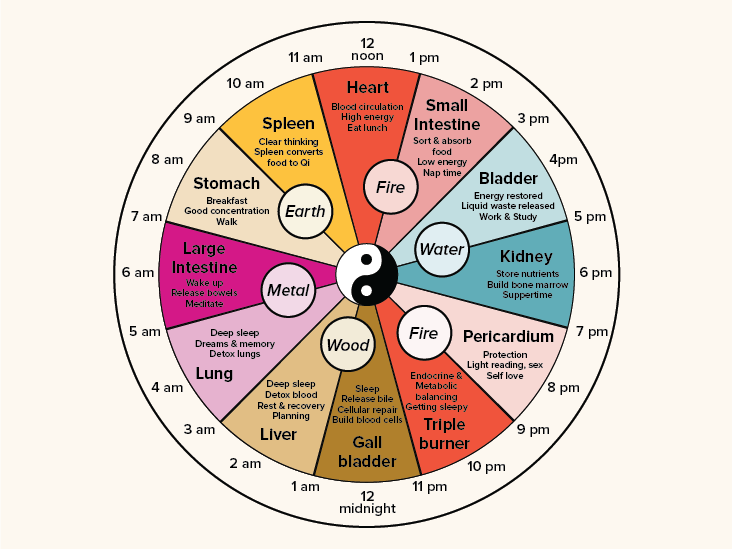
Chinese Medicine 24hr Circadian Clock ⏰
This clock shows the cycle of qi (energy) in the meridians throughout a 24 hour period. The qi cycles on a 2 hourly basis, and so if you’re finding you’re waking up at a certain time it can point to a disharmony perhaps stagnation or deficiency in that organ & meridian system OR the organ & meridian system on the other side of the clock. For example, you find you wake up at 2am each night, this is the time of the liver. The liver is part of the wood element, and it is often the first to get affected when there is stress, stagnation, and unexpressed emotions. So, to stop you waking up at this time it would be key to balance your liver or wood element, which the liver is a part of. Alternatively (and possibly sometimes concurrently) it could affect the small intestine meridian & organ system which is on the other side of the clock at 2pm. 2am is when the qi is strongest in the liver but weakest in the small intestine so problems can show up here. All of these things are going through your practitioner’s mind when they’re going through a consult with you. They are getting to the root of why your sleep is disturbed, what meridian system is out of balance.
As we know, the qi is cycled through all the meridians through a 24 hour period. So, overtime if left untreated minor complaints, in this blog we’re talking about sleep, can slowly get worst and affect multiple meridian systems making it more complicated and time consuming to treat. This could be true for any niggling sign/symptom you have. Don’t feel disheartened by this. It is not impossible to treat, it is just adjusting your expectations that if you’ve had poor sleep for 10 years, it is unlikely to resolve completely in 1 or even 2 treatments.
How Acupuncture Can Help Insomnia
Acupuncture treatment is never based solely on the symptom of poor sleep. During your consultation we look at your overall health, lifestyle, digestion, stress levels, menstrual health (where relevant), emotional wellbeing and sleep pattern to understand the underlying imbalance.
Treatment may include acupuncture, Chinese herbal medicine, dietary guidance and lifestyle recommendations tailored specifically to your constitution.
FAQs
Can acupuncture help insomnia?
Acupuncture is commonly used to support people experiencing difficulty falling asleep, waking throughout the night, or waking feeling unrefreshed. Rather than treating insomnia as a single condition, Chinese medicine looks at the underlying pattern contributing to your sleep disturbance.
Following a thorough consultation, treatment is tailored to your individual presentation and may include acupuncture, dietary and lifestyle recommendations, and where appropriate, Chinese herbal medicine. While many people choose acupuncture as part of their approach to improving sleep, the number of treatments and individual response can vary depending on the underlying cause and how long symptoms have been present.
How many acupuncture treatments are usually needed for sleep?
There is no one-size-fits-all answer. The number of treatments recommended depends on factors such as the duration and severity of your sleep concerns, your overall health, and the underlying pattern identified during your consultation.
In general, more recent sleep disturbances may respond differently to long-standing or complex presentations. After your initial consultation, we'll discuss a personalised treatment plan, including the recommended treatment frequency and expected review points based on your individual needs.
Why do I wake at the same time every night?
There are many possible reasons someone may wake at the same time each night. Stress, hormone changes, blood sugar regulation, environmental factors, medications and other health conditions can all influence sleep.
In Chinese medicine, the timing of night waking may also provide additional information about patterns of imbalance within the body. One traditional framework, known as the Chinese Medicine Horary Clock, associates different two-hour periods with different organ systems. While this isn't used in isolation to make a diagnosis, it can provide another piece of information alongside your overall health picture to help guide treatment.
Can Chinese herbal medicine help insomnia?
Chinese herbal medicine has been used for centuries as part of a traditional approach to supporting sleep. Rather than using the same formula for everyone, prescriptions are tailored to the individual's presentation following a comprehensive assessment.
Herbs are selected based on the underlying pattern identified during your consultation and may be prescribed alongside acupuncture where appropriate. As with acupuncture, treatment is individualised, and recommendations are made based on your health history, current medications and overall presentation.
Looking for Support with your sleep?
Sleep is one of the body's greatest healing tools. While occasional restless nights are normal, ongoing sleep disruption is often a sign that something deeper needs support.
At Ochre Acupuncture & Wellness, we take the time to understand why your sleep has changed so treatment can be tailored specifically to you. Whether you're struggling to fall asleep, waking through the night or feeling exhausted despite sleeping, our goal is to support your body back towards balance.
If you're looking for acupuncture for insomnia in Shellharbour or the surrounding Illawarra region, we'd love to support you.